
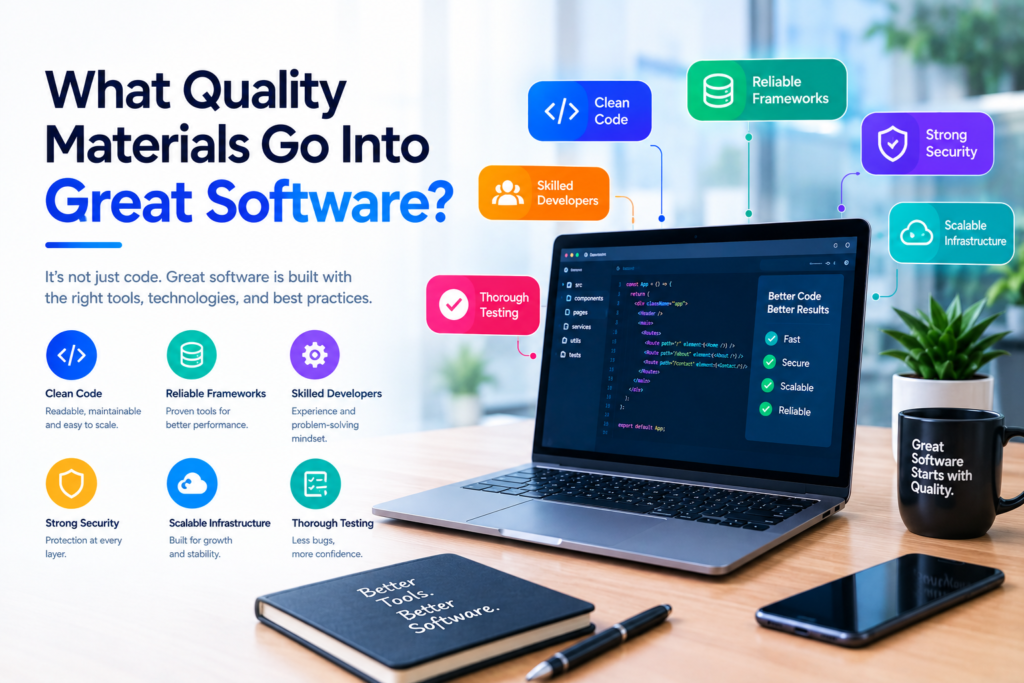
You can see the materials in a building. Software has materials too, but you cannot see them. Code, libraries, databases, servers, and design all shape how your product performs. Weak materials fail under pressure. What does quality look like in software, and how can you check it?
What Are “Quality Materials” in Software?
Software materials are the parts a team builds with. They include source code, frameworks, libraries, databases, cloud infrastructure, APIs, design systems, and security tools. Each part affects speed, safety, and cost. A team that picks strong parts gives you software that lasts.
[Add verified statistic: share of software budgets spent on maintenance and bug fixes, with the source name]
Why Do Quality Materials Matter for Your Business?
Poor parts create bugs, slow pages, and security gaps. Fixes cost more after launch than during the build. Developers call that extra cost technical debt. Your customers leave when a site loads slowly or breaks. Your team loses hours on workarounds. Strong materials cut those costs from the start.
Which Materials Decide Software Quality?
Seven parts matter most.
| Material | What good looks like | Risk when weak |
|---|---|---|
| Source code | Clean, documented, and reviewed by a second developer | Bugs and slow changes |
| Frameworks and libraries | Actively maintained, widely used, and updated | Security holes and abandoned tools |
| Database | Structured, indexed, and backed up | Slow queries and data loss |
| Cloud infrastructure | Scalable, monitored, and redundant | Outages and high bills |
| APIs and integrations | Documented and versioned | Broken connections between tools |
| Design and user experience | Consistent, accessible, and tested with real users | Confusion and lost customers |
| Security tools | Encryption and strict access controls | Data breaches |
How Do Teams Check Code Quality?
Good teams follow clear habits. A second developer reviews every change. Automated tests run on each update and catch errors early. The team keeps coding standards and writes documentation, so a new developer can pick up the project. Version control, such as Git, records every change and lets the team undo mistakes.
Do you need to read the code yourself? No. Ask your partner to explain their review and test process in plain language.
[Add verified statistic: cost of fixing a defect late in development versus early, with the source name]
How Do You Pick Reliable Frameworks and Libraries?
A framework is a base that speeds up development. Choose one with care. Check four points:
- Maintenance: Developers release updates often.
- Community: Many teams use it, so help is easy to find.
- Security record: The maintainers fix flaws fast.
- License: The terms allow your business use.
Avoid obscure tools that only one developer understands. If that person leaves, your project stalls.
What Does Quality Cloud Infrastructure Look Like?
Your software needs a strong home. Quality infrastructure scales when traffic grows. It runs automatic backups, monitors performance, and alerts the team when something looks wrong. It also has a plan for recovery, so a failure does not take you offline for long.
[Add verified statistic: average cost of IT downtime for small businesses, with the source name]
How Does Quality Apply to AI Solutions?
AI tools depend on their inputs. Poor data produces poor answers. A good team cleans your data, picks the right model, and tests the output before launch. A person reviews important results. The team also limits what the AI can access, so your private data stays protected.
What Red Flags Show Poor Quality Materials?
Watch for these warning signs:
- The team uses outdated libraries and skips updates.
- Nobody writes tests or documentation.
- No backups exist, or nobody tests them.
- One developer holds all the knowledge.
- The team cannot name the tools it uses.
- A partner promises “perfect” software, because no honest team can.
Walk away when answers stay vague.
What Questions Should You Ask Before You Hire?
Bring these questions to your first call:
- Which frameworks and tools will you use, and why?
- How do you review and test code?
- How do you document the project?
- Who owns the code and the data after launch?
- How do you handle updates and security fixes?
- What happens if a developer leaves the project?
Clear answers show a team that cares about quality.
How Does SoftaiCore Choose Its Materials?
SoftaiCore is a software and AI company. We offer custom software, AI solutions, and cloud infrastructure. [List your real practices here, such as code review, automated tests, tools you use, and backup routines. Keep only what your team does.]
Do you want to know which materials fit your project? A short call answers that question.
What Should You Do Next?
Ask your current developer three questions today. Which tools do you use? How do you test? Where are my backups? Their answers tell you a lot. Share the results with us, and we reply within [1 business day] with clear next steps.
Discover innovative software solutions, AI-powered technology, web development, and digital marketing services at Softaicore to help your business grow online.